
What Belém Made Clear: Movements are the Real Leaders of Climate Action

by Zanele Sibanda
Vice President of Global Programs, Thousand Currents
I had the privilege of being in Belém for both COP30 and The People’s Summit, where so much of the world’s attention and expectation hinged on what would unfold inside COP during the formal negotiations. But it was outside of the halls of the Blue Zone, in the People’s Summit, where decisive action, bold commitments, and real collective power was demonstrated.
The People’s Summit was a resounding reminder that the heart of climate action is alive across diverse communities in the Global South, where people defend land, water, food, and life every single day. More than 30,000 people from 62 countries came together to strategize collectively on essential issues such as food sovereignty, energy transition, and collective care for land and life. In each discussion, the focus was on solutions that center equity and justice. Thousand Currents supported more than 30 movement formations from Latin America and the Caribbean, Africa, and Asia and the Pacific, who participated in organizing the Summit, shared solutions, and marched for climate justice.
For two weeks, Belém became a living map of movement solutions and movement action. Indigenous Peoples, Quilombola communities, women farmers, youth organizers, agroecology collectives, fisherfolk, forest defenders, and movement allies gathered. Set against the backdrop of the Amazon, their presence transformed the city into a territory of struggle and imagination.
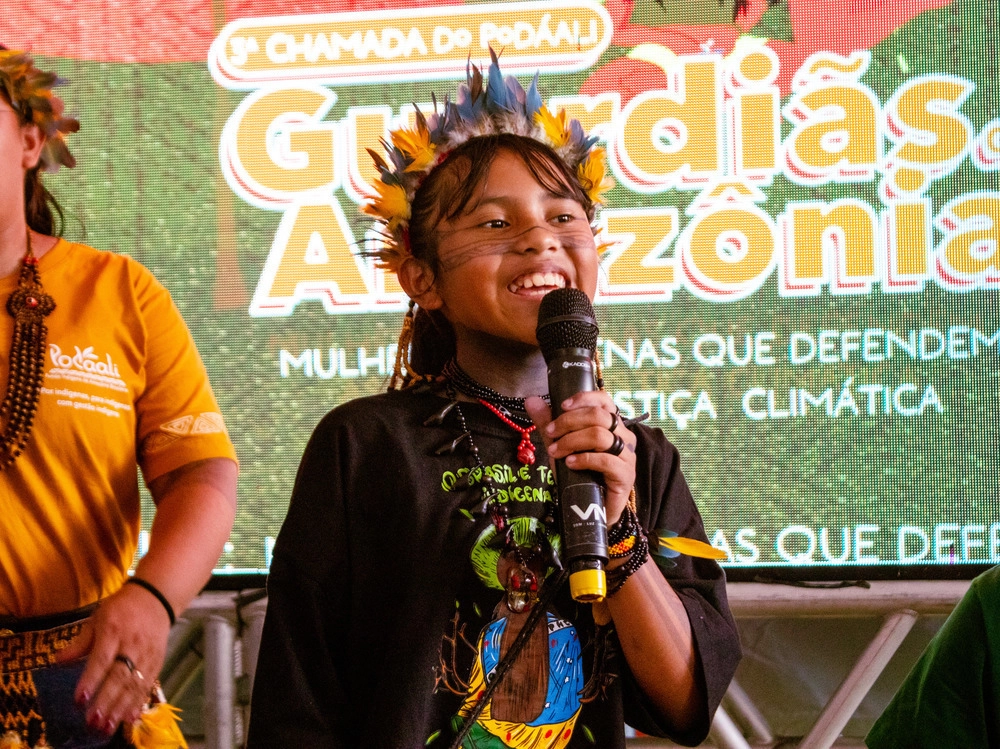
Youth speaker at the event “Guardians of the Amazon: indigenous Women in Defense of Lives and Climate Justice” hosted by Thousand Currents’s partner, Fundo Podáali. Photo credit: Lírio Moraes
What stood out most was the clarity with which people affirmed their relationship to land and territory. In speeches, rituals, assemblies, and songs, participants insisted that forests are not just carbon offsets, market commodities, or climate instruments. Forests are home, memory, and a living political subject. This was most poignantly expressed by the Indigenous Peoples of Brazil. “The Amazon is not for sale,” declared an Indigenous Elder during a session on an inclusive and just transition in the Amazon. Another leader said, “We are the forest. We are the river. We are the climate solution.” They spoke these words not as slogans, but as truths passed down through generations, and lived out daily through the choices and actions of peoples who are collectively stewarding territories like the Amazon and preserving the world’s biodiversity. They do this not only as a practice of living in harmony with the planet, but as a core expression of who they are–many putting their lives on the line in the process.
One of the most striking moments of the Summit was the mass flotilla that kicked off the gathering. More than 200 boats filled the Guamá River, led by Indigenous peoples, Ribeirinho communities, and fisherfolk who arrived with strength and conviction about what we collectively need to do to curb growing emissions that fuel climate change. To see the river alive with political purpose was to understand the scale of movement determination. As a Ribeirinha woman said, “We come by the river because it is our road, our mother, our history. Climate justice begins here.” The flotilla was not a performance. It was a declaration of sovereignty.
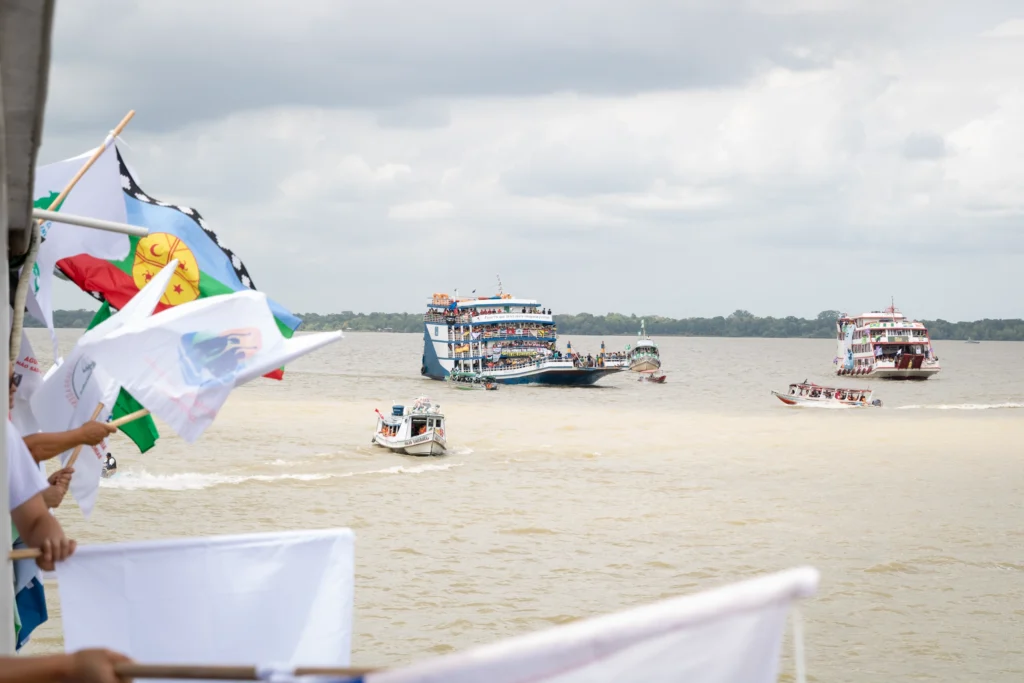
The People’s Summit Flotilla. Over 5,000 people aboard 200 boats kicked off the People’s Summit. Photo credit: Amanda Magnani
Throughout the Summit, agroecology networks brought forward the living practices that sustain territories: seed exchanges, food fairs, women-led cooperatives, youth climate brigades, forest restoration circles, and lessons on territorial markets that keep food close to land and community. Their actions are evidence of real solutions already in motion. In a discussion on transforming food systems for a just and equitable transition, a young agroecology organizer was defiant, “We’re not here to ask governments to save us. We are showing that we are already saving our territories.”
Indeed, governments and corporations need to do their part. And to that end, the Summit was uncompromising when needed. The Munduruku people, represented by their broader movement Munduruku Ipereğ Ayũ and its organizations, such as Thousand Currents partner Associação das Mulheres Munduruku Wakoborun, successfully led a peaceful blockade of the Blue Zone gates demanding recognition, not as stakeholders but as peoples whose territories are under assault. Security barriers met them, but that did not quiet their voices. “How can solutions be decided without us?” a Munduruku youth asked through a megaphone. Their defiance was not a request for inclusion. It was a refusal to let states and corporations negotiate the future of their lands without those who have lived and protected the territories for generations.
Across assemblies, debates, and ceremonies, movements articulated a political project far more coherent and visionary than anything emerging from the official negotiations: demarcation and protection of Indigenous lands; the defense of forests and waters as living beings; the end of fossil fuels; community-owned renewable energy; women’s leadership; and the rejection of carbon markets and extractive “green” development projects. In these spaces, people practiced a different kind of governance, one rooted in ancestral wisdom, solidarity, cultural continuity, and territorial rights. It became clear that movements were not merely demanding change; they were modeling it.
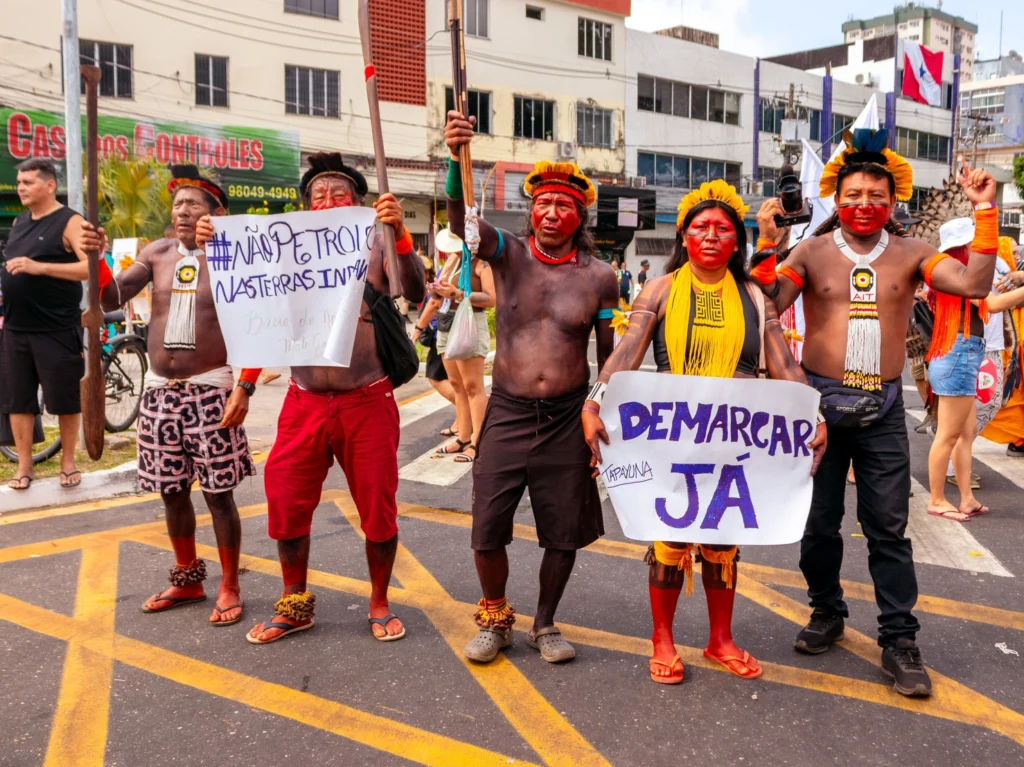
“No to oil in Indigenous lands”, “Demarcation now”. Indigenous demands from the People’s March, November 15, 2025. Photo credit: Lírio Moraes
There was also an unmistakable sense of cultural power running through the Summit. Songs, murals, dances, and rituals created a political atmosphere grounded in dignity rather than despair. The cultural expression was a declaration of identity, belonging, and collective memory. It reminded everyone present that movements are not just fighting for policy, they are fighting for the lives of people who have long lived in harmony with their ecosystems.
Belém revealed that movements are already leading the transition. Real climate leadership is coming from the ground up. Communities are developing the most durable climate solutions. They are building regenerative systems based on centuries of wisdom, and an ongoing commitment to making people’s lives better.
From the rivers to the forests, from women’s assemblies to youth brigades, from seed keepers to community energy organizers, movements showed that they possess political clarity, organizational strength, and deep territorial legitimacy. They are not waiting for states to act. They are already building the world that governments and negotiations struggle to imagine.
Movements collectively made the future visible: one shaped by the courage, creativity, and sovereignty of the people who defend land and life. Its resonance will not fade.
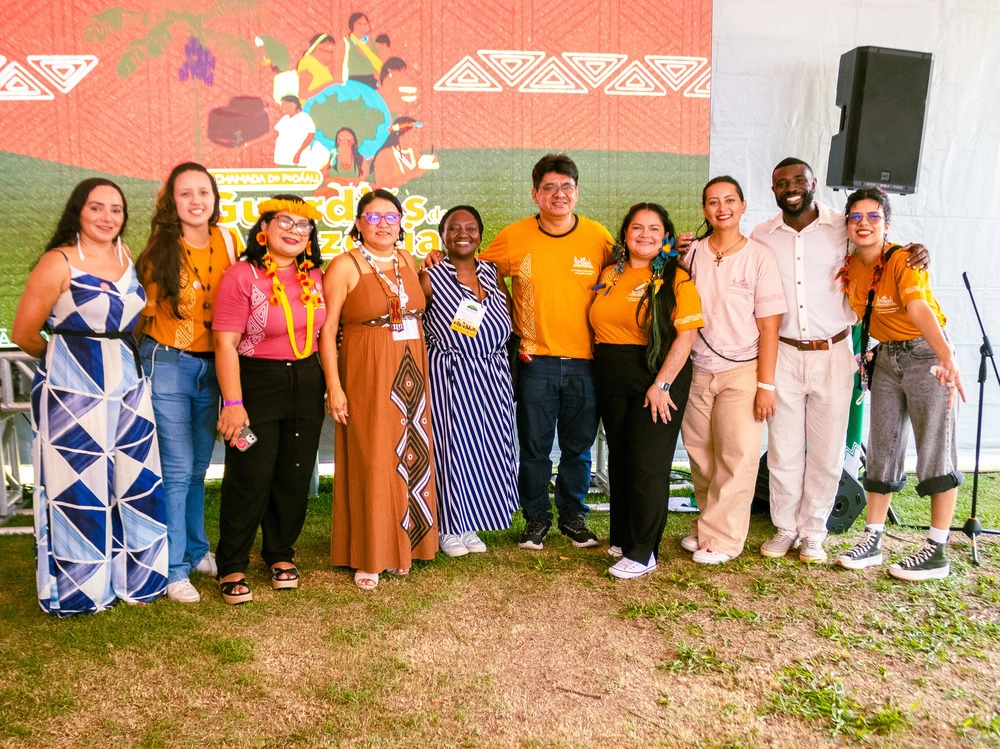
Thousand Currents and the Fundo Podáali team at the event “Guardians of the Amazon: Indigenous Women in Defense of Lives and Climate Justice”.
Cover image: “Nothing about us, without us”. Thousand Currents’ partner The Movement of People Affected by Dams (MAB). Photo Credit: Lírio Moraes
